David Willetts has given an interview to Times Higher Education to coincide with the launch of his new pamphlet.
At the end he broaches an issue I’ve flagged up repeatedly over the last fives years – changing corporate form and ditching charitable status.
“It is still a source of frustration for me that international chains like Laureate or Apollo grow when there isn’t really a British equivalent.
“A lot of universities have a trusteeship model: we’ve been around a long time, our job is to pass it on to the next generation much as it is now.
“If you want to operate like that, fine; but we need some universities with an enterprise model – to recognise a fantastic opportunity to operate in five continents, to double or treble in size, to become a great British export.
“I did think – and I still hope – that one or two universities would convert into a limited company in order to raise a large amount of money and expand. I had commercial investors saying to me that if British higher education came up with an investable proposition, they would put a billion into creating a global chain.”
Since Etingen has just bought University of Law, perhaps David will get his wish.
The UK’s vice-chancellors have published their delayed report into undergraduate student funding.
Although the press release highlights a call for improved levels of maintenance support, the full report indicates that this is a priority if there is additional funding available. Given recent announcements about further cuts to BIS’s higher education budgets, this has the feel of an empty protestation particularly as the coded message of the report is to make graduates pay more rather than levy cuts on university budgets.
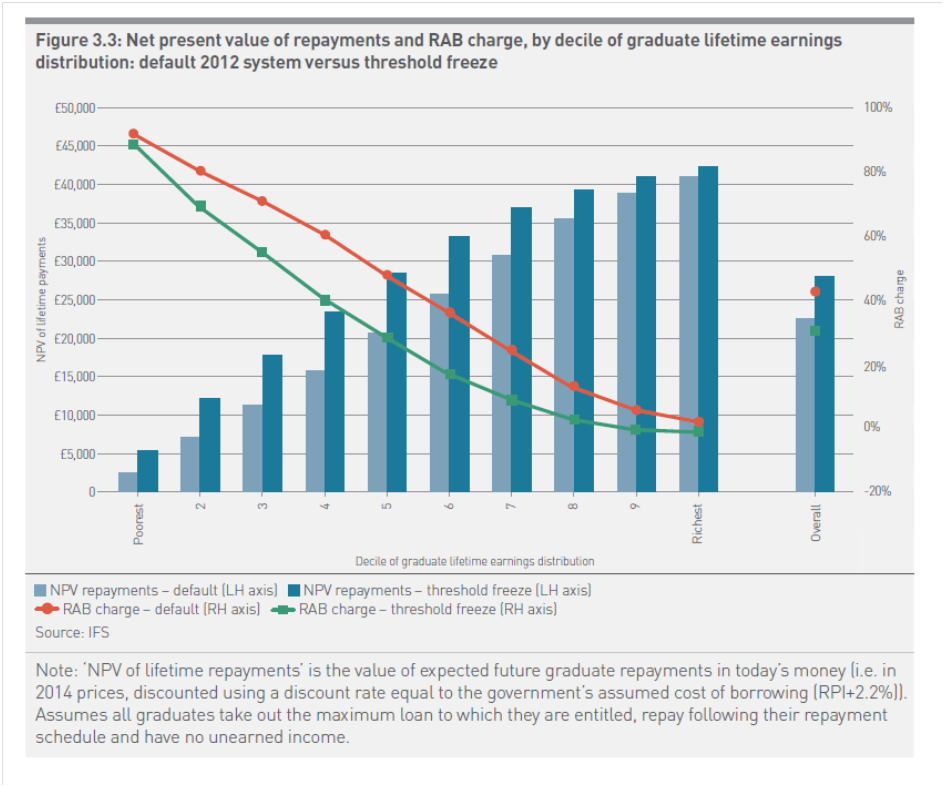
By far the most significant sections in Student Funding Panel repeat Hefce’s recent concerns about the medium-term sustainability of university activities, given their current income and ability to generate surpluses, and then models how a freeze to the loan repayment and interest rate taper thresholds for several years after 2016 can bring the ‘RAB charge’, which covers the public subsidy on loans, down to ‘sustainable’ levels.
The impact of this policy is modelled on the ‘2012 cohort’ suggesting that this policy would see loan terms changed for existing borrowers. The panel suggests that this policy has several virtues, but the image below (taken from the report) shows how such a policy change would fall on the lower deciles in terms of a proportional increase in repayments (dark blue columns are lifetime repayments in NPV terms modelled for the proposals).
The report repeatedly presents this proposal in the conditional: e.g. ‘If concern about the long-term costs to government of the loan subsidy increases in the short term, then some modifications to the system could be made’; ‘Were changes to become necessary’.
This amounts to a disavowal of what the panel knows full well: that recent changes to the departmental budgeting specifically target reducing the RAB charge from the current official figure of 45-46% to 36%. BIS must find ways to reach that target or see year-on-year reductions to other spending, over and above the new £450million cuts announced for this year.
Why they choose not to make this clear is a mystery unless you think that they wish to distance themselves from pushing the ‘threshold freeze’ as a solution to BIS’s budgetary problems. ‘Make graduates take the hit, spare our incomes, if you feel you have to.’
For all the evidence gathered in the report, the panel don’t appear to have asked their focus groups or questionnaire respondents how they would feel about such retrospective changes to loan terms. There’s a risk here of serious damage to the public perception of universities and the HE system, that senior political figures and university management have not gauged properly.
As an aside, a reader of the report might come away with the impression that the RAB charge is some kind of external performance indicator we use to measure HE funding systems. It may be ‘misleading to focus on the RAB charge as the most significant indicator of the impact of the reforms’, but (hint) people focus on that charge because it scores in departmental budgets and accounts and the volatility involved in its calculation has significant implications.
In the 2013 Spending Round, £4.4billion was allocated to cover RAB for financial year 2015/16 before the recent deteriorations in projections were recognised. To cover the increase from 36% RAB to 45% at least an additional £1bn of resource is needed.
George Osborne has today announced £4.5bn of ‘new measures to bring down public debt this year‘.
Business, Innovation & Skills – responsible for further and higher education – has been instructed to save £450m and must make savings in those two areas.
The relevant budgetary measures for BIS is currently somewhere in the region of £13bn, so the cut represents roughly 3.5% of overall planned spending. BIS will be keen to achieve this without touching the cash ring-fence for research.
So where can savings be found? Well, tellingly we had a dress rehearsal for this eventuality in late 2013, when BIS faced a ‘major fiscal challenge’ that was only averted when the Treasury introduced new budgeting conventions for student loans. This allowed unexpectedly high projected losses on new loans to be ‘smoothed’ over the next decades.
I wrote a short blog for the Guardian on where the axe was going to fall back then. It is still relevant.
The most likely candidate for emergency savings on this scale is to convert maintenance grants to loans. This changes grant expenditure (spending that counts towards the deficit) into new loan issues which are classed differently in the accounts (and do not count towards the deficit).
Back in 2013/14, it was thought that by reducing the grant allowance by £1000 per student per year, BIS could save £350million annually. This figure would likely be higher now given the explosion in students studying at private colleges (who proprtionately receive higher levels of grant).
This would be an ‘administrative’ matter that could be achieved without primary legislation but would involve reversing announcements made in February about academic year 2015/16 (starting in September).
One final point. It might be worth noting that no mention was made of student loan sales today. The further sale of Royal Mail was prominent and land sales were also mentioned. The loan sale programme was announced for 2015/16 commenceent in March’s Budget. It proved to be a vexed programme for the coalition. Although it was reported that Osborne promised a loan sale this year at his recent CBI speech, no reference to that appears on the Treasury’s official transcript.
Update
Technical point – if BIS has to find £450m savings so as to help reduce public sector net debt, rather than the deficit, then switch from grants to loans wouldn’t be sufficient as the borrowing used to create loans contributes to the debt. If we are to interpret this strictly as debt reduction measures, then things get trickier for BIS (assuming no loan sale is as yet indicated).
The second of two papers on the Treasury and English higher education has been published as a chapter in a new free e-book from the Political Economy Research Centre at Goldsmiths. It is titled Forging Economic Discovery in 21st Century Britain and includes contributions from Johnna Montgomerie (editor), James Meadway, Will Davies, Andrew Gamble and others.
‘The Treasury View of Higher Education: Student Loans, Illiquid Assets & Fiscal Control’ is the companion to ‘The Treasury View of Higher Education: Human Capital Investment’ which was also published by PERC as a working paper.
The new paper offers a short, more speculative overview of the significance of my recent long studies of student loan accounting and budgeting (last month’s HEPI pamphlet) and attempts to sell student loans to pension funds and insurance companies (March’s London Review of Books article).
It explores that material through two quotes:
- Roy Harrod’s comment that the ‘discount rate’ (used to give a value today to projected future income) is the ‘polite expression for the rapacity’ which the present shows towards the generations yet to come.
- And Rothschild’s advice to government in late 2011 that ‘capitalism is suspended’.
Errata
Unfortunately a couple of errors crept into the article during the editing process. On page 51, two references to ‘PSND’ should be to Public Sector Net Borrowing. The final two paragraphs should read:
Student loans do not impact directly on Public Sector Net Borrowing
PSNDor the current measure of the deficit, except for associated interest payments to creditors. However, student loans do figure in the Public Sector Net Cash Requirement, which is the measure of the additional cash government needs annually to finance itscommitments. This requirement is raised by selling gilts and so drives the level ofpublic debt: each year’s cash requirement adds to that stock.Table 1 illustrates those flows for this year and the next five for the UK overall. My point is not to stress the expense of higher education funding, but to note that the ‘asset-structure’ of loans is formally isolated. These flows are separate, and additional, to PSNB
PSNDor the Current Balance currently used as the basis for the preferred ‘deficit’ measure.
This is a somewhat technical overview of how loans figure in national accounts, headline fiscal statistics (the deficit and the debt), departmental accounts and departmental budgets.
Much of what is in there has been covered on this blog in piecemeal fashion over the last 18 months. It benefits from off-the-record interviews and seeks to shed light on two technical issues: the discount rate and the new budgeting conventions that were introduced retrospectively in 2013/14.
The bottom line is that the accounting and budgeting determines what we mean by the sustainability of the loan scheme in its current form – has BIS been given enough resource to cover projected loan non-repayment? What incentives does it face to control loan outlay and improve graduate repayment levels?
I argue that the new conventions in place mean that BIS will aim to freeze the maximum tuition fee at £9000 for this parliament for the majority of courses at the majority of institutions. In addition, BIS will consider very seriously freezing the repayment threshold at £21 000 after 2016, rather than increasing it in line with average earnings (as has been promised to borrowers).
One further aspect: George Osborne told the CBI last night that we was setting up a new company, a subsidiary of government, to be called UK Government Investments. This would be formed from merging UK Financial Investments and the Shareholder Executive. The latter are/were responsible for attempts to sell the student loans issued to those starting undergraduate study before 2012 (‘pre-2012’ loans or ‘pre-Browne’ loans). Osborne repeated the line that those loans would be sold as they ‘should be in the private sector’. That line needs challenging – the government will likely lose money on any sale and has formalised that by basing its central ‘value for money’ test in a way that would accept a price lower than its value for loans in its accounts.
The new Political Economy Research Center at Goldsmiths has just published my working paper on human capital theory in English higher education. It is a companion piece to another article for PERC that will come out as an e-book relating to the event held there in March, ‘From REcovery to DIScovery – Changing the terms of debate on the economy‘. Both should be read alongside my recent article for London Review of Books on student loan sales and a forthcoming pamphlet for Higher Education Policy Institute on accounting for student loans.
I got to put a question as part of yesterday’s Times Higher Education’s ‘election panel’.
Will the Department for Business, Innovation and Skills have to change the terms for existing borrowers of student loans to balance its budget after 2015? Does your party commit to protecting borrowers’ conditions?
Only two of the four party representatives offered an answer. Greg Clark replied:
The strength of our system is that it is robustly sustainable – as the OECD has confirmed – without any changes in terms being needed.
Now, that’s not a commitment to protecting borrower’s conditions after 2015, but it also sidesteps the issue. It’s a matter of record that the Treasury has set a ‘target’ for BIS to reduce the non-repayment rate on new loans to 36 per cent, from it’s current official figure of 45%.
Without dramatic changes in the graduate labour market, hitting that target in the next parliament would require a Conservative-led government to continue to freeze the maximum tuition fee for the majority of courses (controlling loan outlay) or to freeze the repayment threshold at £21000 in 2017 rather than uprate it in line with earnings (as was originally promised) and thus increasing repayments. And that’s before we consider the overall level of unspecified cuts proposed by David Cameron and George Osborne. Higher Education sits in a department which only benefits from a cash ringfence on research funding.
The OECD comments have become a crutch for Clark, but the official reports from that body have only examined what was in place before 2012. And they haven’t paid any attention to what’s going on in the BIS departmental accounting and budgeting.
In the UK context, ‘Academic Freedom’ as a concept is dominated by the idea that institutions should be free from direct political interference.
The four classic categories are this freedom:
- Freedom to appoint staff
- Freedom to select students (so that Offa can instruct universities to expand their pool of applicants but not task them with changing the results of offers made).
- Freedom to teach (the curriculum is out of bounds to government)
- Freedom to research (invoke “Haldane”!)
This has two consequences:
- The loss of autonomy from partnering with private money – direct or indirect – is poorly sketched or understood and is abstractly – and naively – imagined as a free contract between two private parties (university and funding source);
- The academic freedom of academics is subordinated to the institutional definition. Do the four categories above cascade down to faculty or departmental level? Or are these freedoms the preserve of the executive?
Academic freedom as defended by vice-chancellors and managerial class really means the freedom to act like a business with light regulation, where academics are employees to be instructed and students are customers.
If we are serious about academic freedom for academics, then institutional governance needs overhauling. But it has to be done by academics. No HE legislation in 2015/16 is going to undo chronic managerialism with its bullying and incompetence.
The BIS website has published a letter from Martin Donnelly to Anthony Odgers dated 25 March 2015.
In it Donnelly, the senior civil servant in BIS, empowers Odgers to deliver the student loan sale once a government decision has been made.
Odgers thereby becomes the Senior Responsible Owner and would presumably appear before the Public Accounts Committee instead of Donnelly were that committee to look into the value for money of a sale.
Odgers objective is to deliver a first sale within nine months of ‘Ministerial decision’. In order to get sale proceeds into the 2015/16 financial year – as per the official projections – Odgers would need to be given the go-ahead in June.
Things could move very quickly after the general election. A different Secretary of State for Business may make a different decision to Vince Cable, who vetoed a loan sale last summer.
A sale though still remains ‘broader government policy’.
For more detail on attempts to sell student loans, see my recent essay for the London Review of Books.
Although the Budget has announced a new consultation of postgraduate funding, perhaps more significant is the large downwards revision to future undergraduate numbers contained in the Office for Budgetary Responsibility’s Economic & Fiscal Outlook.
Student numbers in England were expected to rise this year following the removal of the higher education numbers cap, but have done so by considerably less than expected. The latest data on student numbers and applications indicate a more gradual rise than in the original estimate of the cost of this policy change. We originally assumed that student numbers would rise relatively quickly as excess demand was catered for, but there have only been around 10,000 new entrants this year and applications for next year suggest a similar rise in 2015-16. We therefore assume that student numbers will rise by a further 10,000 in 2016-17, to 375,000, but remain broadly stable thereafter. This would still represent a steadily rising proportion of 18-19 year olds. (The ONS population projections that underpin our forecasts show around a 10 per cent decline in the number of 18 year olds in the population between 2015 and 2020.) The forecast also takes account of new postgraduate loans, the introduction of which was announced in Autumn Statement 2014. (paragraph 4.158)
The 2013 Autumn Statement thought that removing student numbers controls this coming September would reach unmet demand of 60 000 places. The OBR has revised down the projections for new student loan outlay to £16.5bn in 2019/20. In December it thought that £18bn would be going out the door each year, indicating that it thinks there will be 100 -150 000 fewer undergraduate students to fund each year. (New Postgraduate loan uptake is included in that £16.5bn).


 Critical Education